Intel’s 2025 Outstanding Researcher Awards Honor 10 Academic Innovators
Recognizing breakthrough university research advancing the future of technology through deep academic collaboration.
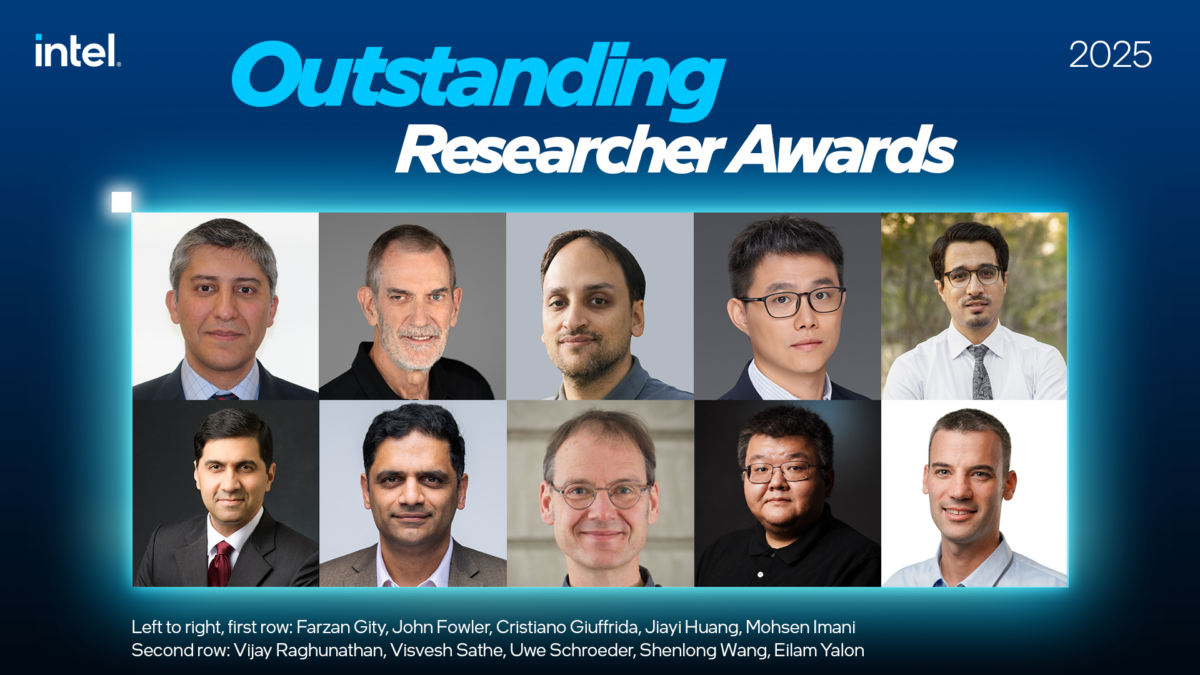
Intel’s 2025 Outstanding Researcher Awards (ORAs) recognize academic leaders whose breakthroughs are shaping what’s next, from foundational science to real-world impact.
The annual program spotlights exceptional work from Intel-sponsored university research, advancing Intel’s mission to create world-changing technology that enriches the lives of every person on Earth. Led by Intel’s Corporate Research Council, the ORAs drive collaboration with top universities, research centers, and ecosystem partners.
The winners of Intel’s 2025 Outstanding Researcher Awards are:
John Fowler / Arizona State University
AI Assisted Digital Twins for Supply Chain
Creating and implementing supply chain digital twins continues to be expensive and time-consuming. This research utilized generative AI and reinforcement learning methods to automate simulation development, validation, and enhancement processes. An innovative two-phase framework featuring structured intermediate representations (employing a specialized LLM) substantially enhanced efficiency and precision compared to general-purpose LLMs, minimizing development resources and facilitating scalable, reliable digital twins for practical supply chain management.
Farzan Gity / Tyndall National Institute
Role of Grain Boundaries (GBs) in TMDs on carrier transport: identifying GB structure-electrical property correlation
This project established detailed connections between grain boundary configuration and electrical behavior in 2D transition metal dichalcogenide devices. By integrating modeling techniques with experimental characterization, it determined which grain boundary structures severely compromise carrier conduction in MoS₂ and WSe₂. The outcomes provide vital guidance for material engineering and device architecture, directly enabling the creation of enhanced 2D channel materials.
Cristiano Giuffrida / VU Amsterdam
Allocamelus: Efficient Memory Safety
Delivering complete memory safety with minimal performance impact continues to be a persistent challenge in contemporary software systems. This research provided rapid and modular defense against spatial and temporal memory vulnerabilities by integrating secure memory allocation with runtime monitoring enhanced by current Intel processor capabilities. By utilizing features like Linear Address Masking and the floating-point unit, the solution scaled effectively to large, unchanged applications while identifying potential future hardware acceleration possibilities.
Jiayi Huang / Hong Kong University of Science and Technology (Guangzhou)
Software and Hardware Prepush Multicast
As processor core counts increase and workloads become more data-intensive, on-chip bandwidth and latency face mounting challenges, especially when handling frequently accessed shared data. This research introduced an efficient multicast solution for last-level caches and on-chip networks using precise sharer prediction and an innovative pre-push mechanism. The approach proactively distributes shared data through a streamlined software-hardware interface, eliminating unnecessary traffic and substantially enhancing network-on-chip efficiency and application performance for AI and datacenter applications.
Mohsen Imani / University of California, Irvine
Efficient and Interpretable Symbolic AI for Intelligent Reasoning and Decision Making
Next-generation brain-inspired computing approaches provide an attractive alternative to standard deep learning frameworks. This research enhanced efficient and transparent symbolic AI using hyperdimensional computing, demonstrating orders-of-magnitude improvements in training and inference efficiency, while preserving excellent reasoning capabilities. The work created new adaptable, energy-conscious algorithms at the convergence of hyperdimensional computing, probabilistic machine learning, reinforcement learning, and active learning, showing outstanding results with thousands-fold performance and power enhancements.
Vijay Raghunathan / Purdue University
Multimodal System Understanding and Heterogenous AI compute across CPU, GPU and NPU
Next-generation AI systems increasingly require the coordinated use of diverse computing engines to deliver high performance and energy efficiency at scale. The research advanced heterogeneous AI computing across CPUs, GPUs, and NPUs for transformers, vision-language and vision-language-action (VLA) models, graph neural networks (GNNs), and newer AI architectures such as Mamba and state space networks (SSNs), including applications in multimodal and embodied AI. The work introduced new techniques for cross-accelerator coordination that improved performance and energy efficiency, while informing the evolution of Intel’s next-generation AI platforms and system architectures.
Visvesh Sathe / Georgia Institute of Technology
Runtime Thermal Management in Scaled 3D SoC Technologies – Circuits, Techniques and Architectures
Effective thermal management in advanced 3D system-on-chip designs demands precise, low-overhead sensing solutions. This research developed compact digital temperature sensors powered by Vdd, featuring high precision, minimal noise interference, and simplified single-point calibration. Through validation across multiple test chips and firmware implementations, these sensors provide process-scalable, detailed thermal monitoring that ensures reliable and energy-efficient performance in cutting-edge semiconductor technologies.
Uwe Schroeder / NamLab gGmbH & Eilam Yalon / Technion – Israel Institute of Technology
Understanding and controlling the growth and properties of ferroelectric HZO-based device stacks
Enhancing hafnia-based ferroelectric devices requires more profound understanding of fabrication processes, defect properties, and switching phenomena at the atomic dimension. This research center established complete insight into strain mechanics, defect formation, and electrode templating for preserving ferroelectric phases and directing polarization switching in GHz operating conditions. These breakthroughs boosted reliability by allowing optimized ferroelectric device configurations for varied high-frequency applications.
Shenlong Wang / University of Illinois at Urbana-Champaign
Harnessing Generative AI for Realistic, Interactive, and Physics-Grounded Virtual Environments
Constructing authentic, interactive digital twins at metropolitan scale necessitates innovations in both generative modeling and physical simulation approaches. This research developed computational methods and software architectures for comprehensive, photorealistic, and physics-informed virtual environments by merging generative models with multimodal mapping and physics-based simulation techniques. The developed platforms supported immersive digital twin applications and furthered Intel's strategic roadmap for 3D content creation and simulation computing.
Related Posts
 Artificial Intelligence

Intel and Google Cloud Announce Collaboration to Accelerate Intel’s AI-Enabled Enterprise Transformation
Collaboration leverages Gemini Enterprise and Google Cloud to expand Intel’s AI workforce capabilities via scalable agentic workflows across core business functions
July 16, 2026
Corporate

Intel to Report Second-Quarter 2026 Financial Results
Intel will deliver its report after market close on July 23.
June 30, 2026