
Intel Named One of America’s Most Innovative Companies by Fortune
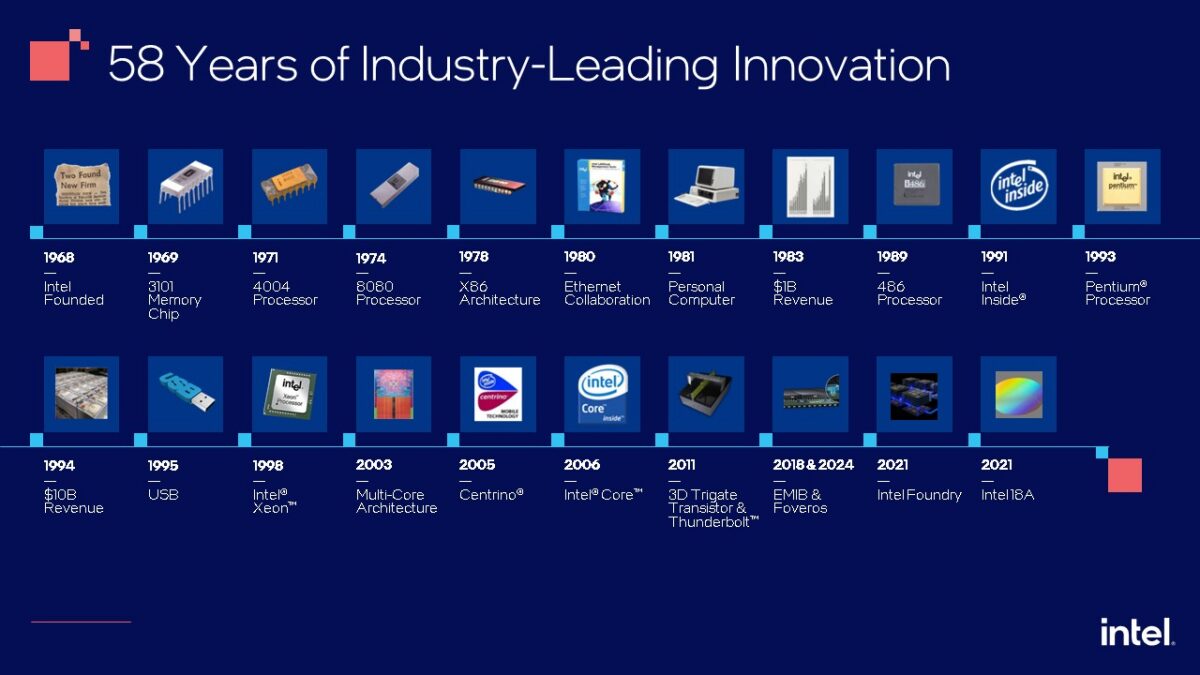
Underscoring long-standing legacy of industry-leading innovations.
What’s new: Intel has been named one of Fortune’s Most Innovative Companies, recognizing the company’s long-standing leadership in semiconductor innovation and its continued momentum in advancing artificial intelligence, computing and global semiconductor manufacturing.
Why it matters: Innovation has defined Intel since its founding—and continues to drive the company’s transformation as it builds the technologies that power today’s digital economy.
The big picture: From inventing the microprocessor to enabling the intelligence era, Intel innovations have helped shape entire industries, while laying the foundation for the next generation of computing.
By the numbers:
- 58 years of innovation leadership and counting
- More than 64,000 active Intel patent assets worldwide
- Intel technologies power an estimated 70% of the market for microprocessors in desktop and laptop computers
Zoom in: 5 Intel Innovations Shaping the Industry
A selection of Intel innovations with outsized industry impact that continue to inform the company’s strategy today.
- The First Microprocessor (1971): Intel’s 4004 put a computer on a chip—launching the modern computing era and enabling the digitization of entire industries. That foundation continues today, powering a new generation of AI-driven platforms that scale intelligence from data center to edge to client.
- x86 Architecture (1978–Present): Established the foundation for modern computing platforms across PCs, servers, and enterprise systems. x86 continues to evolve to support AI, cloud and high-performance workloads at global scale.
- Intel® Core™ Processors (2006–Present): Redefined PC performance and energy efficiency for mainstream computing. Today, the portfolio spans from Intel Core to Intel® Core™ Ultra, extending that legacy into premium, AI-powered PCs with built-in accelerators designed for next-generation client experiences.
- Advanced Packaging (EMIB 2018–Present: Foveros 2024–Present): Enabled chiplet-based architectures by integrating multiple dies into a single package. Advanced packaging is critical to scaling performance in AI, data center and high-performance computing workloads.
- Intel 18A Process Technology (2025–Present): Intel’s next-generation semiconductor node, incorporating innovations such as RibbonFET gate-all-around transistors, and PowerVia backside power delivery. 18A marks a critical milestone in restoring process leadership and enabling the next wave of high-performance, power-efficient computing—especially for AI and advanced workloads.
What’s next: Intel is advancing the innovations that will power the intelligence era.
- Scaling AI through open, heterogeneous systems: Enabling AI to run across data center, cloud, edge and client through open software stacks and interoperable platforms that combine CPUs, GPUs, NPUs and accelerators—giving customers the performance, efficiency and control to scale AI on their terms.
- Advancing x86 as the CPU platform for the intelligence era: Evolving the world’s most widely deployed compute architecture to meet the demands of AI—powering everything from AI PCs to hyperscale data centers, and serving as the control plane for increasingly complex, distributed workloads.
- Building a trusted, leading-edge foundry: Advancing process technology (including Intel 18A, Intel14A and beyond), pioneering innovations like RibbonFET and PowerVia, and scaling advanced packaging with EMIB and Foveros to energize architectures, delivering full-stack, co-optimized innovation backed by resilient, sustainable manufacturing and the largest leading-edge capacity in the United States.
Together, these pillars deliver something unique in the industry: US-based leading-edge R&D and manufacturing enabling an open, end-to-end compute platform—from silicon to systems to software—engineered to scale AI with confidence.
Bottom line: Intel’s inclusion on Fortune’s Most Innovative Companies list reflects both its history of foundational breakthroughs and its ongoing transformation to lead in AI, advanced computing and semiconductor manufacturing.
Related Posts
 Corporate
Intel Announces Upsize and Pricing of $20 Billion Common Stock Offering
Intel today announced the pricing of its previously announced registered public offering of common stock. The offering is expected to close on August 12, 2026, subject to customary closing conditions.
August 10, 2026
Corporate
Intel Announces Proposed $15 Billion Common Stock Offering
Proceeds intended to support general corporate purposes, including capital expenditures and working capital.
August 10, 2026